



.png?width=520&height=294&name=Untitled%20design%20(20).png)
Legal Tech
Immigration attorneys are busy. It’s easy to miss follow-ups. Conversations with prospective clients get scattered across five different places. Inquiries grow cold, prompting the search for an immigration CRM. But contact management and lead tracking are only part of the job.
Immigration firms do need to manage client relationships, but it’s their skill at case management that pays the bills. They need software that handles forms and filings, tracks deadlines, and integrates with outdated government systems that don’t forgive mistakes.
Traditional CRMs weren’t built for immigration work. And most case management tools aren’t built to handle client relationships. So firms stack tools. One for prospecting. One for cases. Inevitably, neither talks to the other, which adds to an already back-breaking workload.
This guide breaks down the real differences between an immigration CRM and case management software. It shows where each falls short on its own, and what it looks like when both live in one system—because you shouldn’t have to choose between managing clients and managing cases.
What immigration professionals mean when they search for "CRM"
When immigration professionals search for "CRMs," they often have a different expectation than people in other industries. For most businesses, CRM stands for Customer Relationship Management and focuses on acquiring and converting clients at scale. It tracks leads, manages contacts, automates outreach, and supports sales pipelines with features like email campaigns and conversion rate reporting.
In immigration law, the term CRM is used more broadly. Different firms have varying needs, which may include lead tracking, scheduling consults, follow-ups, intakes, and case management. Most CRMs, like HubSpot and Salesforce, cater more to high-volume practices such as personal injury and family law. Success in these practice areas relies heavily on efficient intake processes and quick conversions.
Immigration law is different. Cases often take months or years to resolve, and legal teams need to communicate with clients about updates, documents, and reminders every step of the way.
So when immigration professionals seek a "CRM," they’re often trying to address comprehensive client management throughout the case lifecycle.
What is immigration case management software?
Immigration case management software is purpose-built to manage the full lifecycle of an immigration case.
Attorneys use platforms like eimmigration, LollyLaw, and CampLegal to gather client info, prepare forms, and submit cases for processing. These tools also automate workflows for petitions and renewals, and track deadlines and case statuses. Immigration platforms include client portals that store a client’s records and collect payments.
Many general legal case management tools exist, but immigration-specific solutions can handle the unique requirements of immigration law.
CRM vs. case management software: What's the difference?
Here’s the simplest way to think about it: CRM handles the relationship, captures leads for immigration firms, manages intake, and organizes client communication. Case management handles the case work—forms, filings, deadlines, and everything required to move a case forward.
Immigration practices need all of these capabilities in one platform. The problem is, most tools force you to choose. Here’s how they actually compare.
Comparison table
|
Capability |
CRM Software |
Case Management |
eimmigration |
|
Lead capture and tracking |
Yes |
Rarely |
Yes |
|
Client intake and onboarding |
Yes |
Sometimes |
Yes |
|
Marketing automation and drip campaigns |
Sometimes |
No |
No |
|
Email, SMS, and WhatsApp communications |
Sometimes |
Sometimes |
Yes |
|
Client portal |
Rarely |
Sometimes |
Yes |
|
Case workflow automation |
No |
Yes |
Yes (120+ pre-built) |
|
Immigration forms (USCIS, DOL, DOS) |
No |
Yes |
Yes (300+) |
|
e-Filing to government agencies |
No |
Sometimes |
Yes |
|
USCIS case status tracking |
No |
Sometimes |
Yes |
|
Deadline reminders |
Basic |
Yes |
Yes (up to 180 days) |
|
Document assembly |
No |
Sometimes |
Yes |
|
Billing and trust accounting |
No |
Sometimes |
Yes |
|
Time tracking |
No |
Sometimes |
Yes |
|
Custom reports and analytics |
Basic |
Sometimes |
Yes (1,000+ data points) |
|
eSignature |
Sometimes |
Sometimes |
Yes |
|
Multilingual support |
Rarely |
Sometimes |
Yes (13 languages) |
Where a CRM falls short for immigration practices
Generic CRMs weren’t built for immigration work.
❌ They don’t address different visa categories or know what information each form requires.
❌ They also don’t come preloaded with the case-specific workflows that save attorneys time.
❌ CRMs have nothing to do with immigration forms. If this is your firm’s only software, you’ll have to fill out PDFs manually.
❌ They also don’t connect to the USCIS. That means you’ll have to upload files to government sites manually. And staff will have to manually monitor case status.
❌ Deadline tracking is another failure point if all you have is a CRM. A CRM can remind you to follow up with a lead. It can’t tell you that a work authorization expires in 180 days. And it certainly won’t make sure you take action on that reminder by automatically triggering the right workflow for you to follow.
To patch those gaps, firms end up bolting on additional tools to their tech stack. They pay for forms software, filing tools, and deadline trackers. Now, they’re left managing data across multiple systems.
Where basic case management software falls short
While case management platforms effectively handle tasks, they often lack tools for managing relationships. Client portals can be basic or non-existent, leading to fragmented communication. It’s not uncommon to take notes in a Google Doc after a phone call, send follow-up texts, and then email about a meeting, all while trying to remember to update your calendar.
This disconnect is why growing firms need some form of CRM capabilities to handle the client relationship side.
Get the benefits of both with all-in-one immigration software
Here’s the good news: you don’t actually need to choose between CRM and case management.
The best immigration software removes the tradeoff entirely by building both into one system. That means you can manage the client relationship and the case itself without switching tools, syncing data, or losing context between stages.
On the client management side, eimmigration gives you a structured way to capture and convert demand. You can:
- Track leads from first inquiry through conversion
- Send intake questionnaires via secure, passwordless links
- Manage conversations across SMS, email, WhatsApp, and in-app messaging
You can also give clients a portal where they can:
- Check case status
- Upload documents
- Stay connected without constant back-and-forth
- Book meetings without the usual friction
And for corporate immigration, HR teams can initiate cases on employees' behalf without disrupting your workflow.
On the case management side, eimmigration includes 300+ immigration forms. You can e-file those forms with USCIS, DOS, and DOL. Once they’re filed, you can get real-time case status updates via text or email. You also have access to:
- 120+ pre-built workflows across visa types
- Deadline reminders that surface critical dates well in advance
- Document assembly that produces complete, organized filings
- An electronic signature tool to capture client signatures from any device
Billing, trust accounting, and time tracking also live in the same system, alongside reporting that pulls from thousands of data points. Layer in AI-powered tools to automate repetitive tasks, surface insights, and reduce manual work across both intake and casework. Add an advanced security posture that keeps client data isolated, secure, and compliant.
Now the system doesn’t just connect your work, it protects it and speeds it up. One database. One login. No duplicate data entry. And, client information flows directly from intake into forms, workflows, and filings, so conversations stay tied to the case. Nothing gets lost between systems because there aren’t multiple systems to manage.
You don’t need two systems to run one practice
You shouldn’t have to choose between managing client relationships and managing cases. That tradeoff exists because most tools were built to solve one side of the problem, not both. But immigration practices don’t operate in silos.
Data needs to move cleanly from the first inquiry to the final filing. When it doesn’t, things break. Leads slip. Deadlines get missed. Teams waste time reconciling systems instead of moving cases forward.
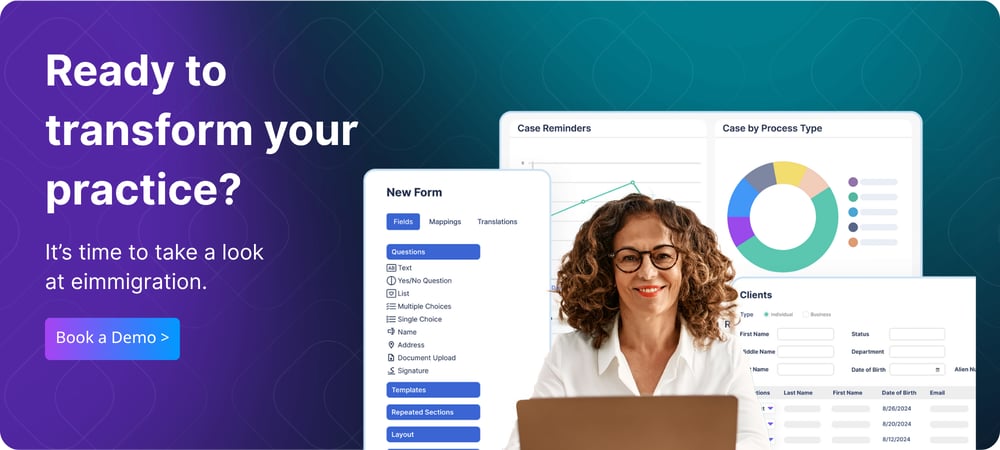
The right platform removes that friction. eimmigration brings client management and case management together in one immigration-specific system, so you can run your practice without juggling tools.
If you want a closer look at an all-in-one system that gives you the best of both worlds, book a demo of eimmigration.


.png?width=552&height=246&name=Capabilities%20CTA%20Image%20(1).png)